
Have you ever thrown a football or cricket ball into the sky, launched a rocket in a video game, or watched a fountain spray water into the air? The path that the water or ball follows in the air forms a curve called a parabola.
In algebra, the math behind this curved path comes from a quadratic equation.
In this article, you will learn what quadratic equations are, how to identify them, and the different types of methods you can use to solve them easily.
What is a Quadratic Equation?
A quadratic equation is a polynomial equation of degree 2. More Precisely, A quadratic equation is a second-degree polynomial math statement where the highest exponent of the variable is two.
Example:
For one variable (x): $3x^2 + 5x + 2 = 0$ (Two points on line),
For two variable (x, y): $x^2 + y^2 = 16$ (Circle), $y = x^2 + 2x$ (Parabola curve)
For three variable (x, y, z): $x^2 + y^2 + z^2 = 25$ (3D Sphere)
Where, $x$, $y$, $z$, etc. are an unknown or variable.
What is a Quadratic Equation in One Variable?
A quadratic equation in one variable is an equation that contains only one single letter (variable) throughout the entire equation, and the highest exponent (power) on that variable is 2.
For example: $2x^2 + 7x + 3 = 0$ (Only variable is $x$)
Standard form of a quadratic equation
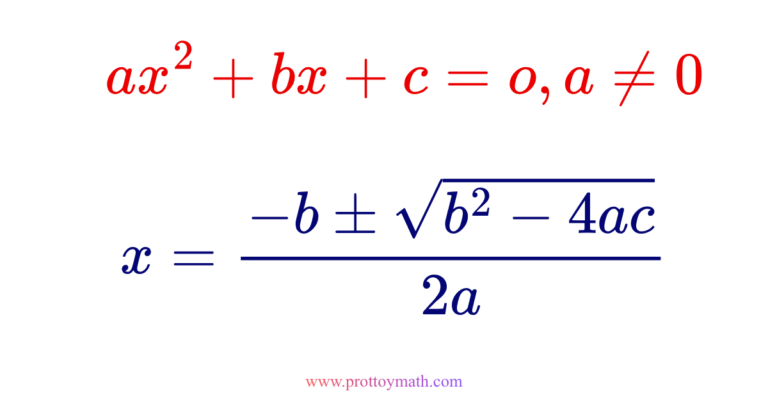
The standard form of a quadratic equation in one variable is:
$ax^2 + bx + c = 0$
Where:
- $x$ is an unknown variable.
- $a$, $b$, and $c$ are real numbers (called coefficients).
- $a \neq 0$ (If $a = 0$, the $x^2$ term disappears, and it becomes a linear equation, not a quadratic one).
Examples
- $3x^2 + 5x + 2 = 0$ (Here $a = 3$, $b = 5$, $c = 2$)
- $x^2 – 9 = 0$ (Here $a = 1$, $b = 0$, $c = -9$)
- $2t^2 – 4t = 0$ (Here $a = 2$, $b = -4$, $c = 0$)
Non-Examples (Not Quadratic in One Variable)
- $x^2 + y^2 = 25$ (This has two variables: $x$ and $y$)
- $x^3 – 2x^2 + 1 = 0$ (The highest power is 3, making it a cubic equation)
How to Solve Quadratic Equations in One Variable
To “solve” a quadratic equation means finding the values of the variable that make the equation true. These values are called the roots or solutions of the equation. A quadratic equation always has up to two solutions.
Here are three primary methods to solve them:
Method 1: Factoring Method (Middle-Term Splitting)
This method works best when the quadratic expression can easily be broken down into two linear factors.
Steps:
- Write the equation in standard form: $ax^2 + bx + c = 0$.
- Find two numbers that multiply to give $a \cdot c$ and add up to give $b$.
- Split the middle term ($bx$) using these two numbers.
- Factor by grouping and set each factor equal to zero to find $x$.
Problem: Solve $x^2 – 7x + 12 = 0$
Solution: $x^2 – 7x + 12 = 0$
$\implies x^2 – 3x – 4x + 12 = 0$
$\implies x(x – 3) – 4(x – 3) = 0$
$\implies (x – 3)(x – 4) = 0$
Therefore,
$x – 3 = 0 \implies x = 3$
Or,
$x – 4 = 0 \implies x = 4$
Method 2: Quadratic Formula Method
This method works for any quadratic equation, even when factoring is difficult or impossible.
The Quadratic Formula:
$x = \frac{-b \pm \sqrt{b^2 – 4ac}}{2a}$
Here is the complete step-by-step solution to solve $ax^2 + bx + c = 0$ (where $a \neq 0$).
Solution: We know, standard form of a quadratic equation is –
$ax^2 + bx + c = 0$
$\implies a^2 x^2 + abx + ac = 0$ [Multiply both sides by $a$]
$\implies (ax)^2 + 2(ax)\left(\frac{b}{2}\right) + \left(\frac{b}{2}\right)^2 – \left(\frac{b}{2}\right)^2 + ac = 0$
$\left(ax + \frac{b}{2}\right)^2 – \frac{b^2}{4} + ac = 0$
$\implies \left(ax + \frac{b}{2}\right)^2 = \frac{b^2}{4} – ac$
$\implies \left(ax + \frac{b}{2}\right)^2 = \frac{b^2 – 4ac}{4}$
$\implies ax + \frac{b}{2} = \pm \sqrt{\frac{b^2 – 4ac}{4}}$ [Take the square root of both sides]
$\implies ax + \frac{b}{2} = \pm \frac{\sqrt{b^2 – 4ac}}{2}$
$\implies ax = -\frac{b}{2} \pm \frac{\sqrt{b^2 – 4ac}}{2}$
$\implies x = \frac{-b \pm \sqrt{b^2 – 4ac}}{2a}$ [Divide both sides by $a$]
Therefore the two roots or values of x are:
$x_1 = \frac{-b + \sqrt{b^2 – 4ac}}{2a}$
$x_2 = \frac{-b – \sqrt{b^2 – 4ac}}{2a}$
The term under the square root, $b^2 – 4ac$, is called the discriminant ($\Delta$).
- If $b^2 – 4ac > 0$, we get two real and distinct solutions.
- If $b^2 – 4ac = 0$, we get one real solution (a repeated root).
- If $b^2 – 4ac < 0$, we get no real solutions (complex numbers).
Problem: Solve $2x^2 – 3x – 1 = 0$
Solution: $2x^2 – 3x – 1 = 0$
Comparing the equation with the standard quadratic form $ax^2 + bx + c = 0$, we get $a = 2$, $b = -3$, $c = -1$
we know,
$x = \frac{-b \pm \sqrt{b^2 – 4ac}}{2a}$
$\implies x = \frac{-(-3) \pm \sqrt{(-3)^2 – 4(2)(-1)}}{2(2)}$
$\implies x = \frac{3 \pm \sqrt{9 + 8}}{4}$
$\implies x = \frac{3 \pm \sqrt{17}}{4}$
The two solutions (roots) to the equation are:
$x_1 = \frac{3 + \sqrt{17}}{4}$
$x_2 = \frac{3 – \sqrt{17}}{4}$
Method 3: Square Root Method
This simple method is used when there is no middle term ($b = 0$), leaving the form $ax^2 + c = 0$.
Steps:
- Isolate $x^2$ on one side: $x^2 = k$.
- Take the square root of both sides: $x = \pm \sqrt{k}$.
Problem: Solve $3x^2 – 12 = 0$
Solution: $3x^2 – 12 = 0$
$\implies 3x^2 = 12$
$\implies x^2 = 4$
$\implies x = \pm \sqrt{4} = \pm 2$
The two solutions are:
$x = 2 \quad \text{or} \quad x = -2$
Practice Problems
Let’s work through some concrete examples together.
Example 1: Solve $x^2 + 5x + 6 = 0$
Solution: $x^2 + 5x + 6 = 0$
$\implies x^2 + 2x + 3x + 6 = 0$
$\implies x(x + 2) + 3(x + 2) = 0$
$\implies (x + 2)(x + 3) = 0$
Therefore, $x + 2 = 0 \implies x = -2$
or,
$x + 3 = 0 \implies x = -3$
Example 2: Solve $x^2 – 6x + 9 = 0$
Solution: Compare $x^2 – 6x + 9 = 0$ with $ax^2 + bx + c = 0$, we get $a = 1$, $b = -6$, $c = 9$
We know, $x = \frac{-b \pm \sqrt{b^2 – 4ac}}{2a}$
$\implies x = \frac{-(-6) \pm \sqrt{(-6)^2 – 4 \cdot 1 \cdot 9}}{2 \cdot 1}$
$\implies x = \frac{6 \pm \sqrt{36 – 36}}{2}$
$\implies x = \frac{6 \pm 0}{2}$
$\implies x = \frac{6}{2} = 3$
Roots: $x_1 = 3$, $x_2 = 3$ (one repeated real root)
Example 3: Solve $x^2 – 2x – 2 = 0$
Solution: Compare $x^2 – 2x – 2 = 0$ with $ax^2 + bx + c = 0$, we get $a = 1$, $b = -2$, $c = -2$
We know, $x = \frac{-b \pm \sqrt{b^2 – 4ac}}{2a}$
$\implies x = \frac{-(-2) \pm \sqrt{(-2)^2 – 4 \cdot 1 \cdot (-2)}}{2 \cdot 1}$
$\implies x = \frac{2 \pm \sqrt{4 + 8}}{2}$
$\implies x = \frac{2 \pm \sqrt{12}}{2}$
$\implies x = \frac{2 \pm 2\sqrt{3}}{2}$
$\implies x = \frac{2(1 \pm \sqrt{3})}{2}$
$\implies x = 1 \pm \sqrt{3}$
Roots: $x_1 = 1 + \sqrt{3}$, $x_2 = 1 – \sqrt{3}$
Example 4. Solve $3 – 4x – x^2 = 0$
Solution: Comparing the equation with the standard quadratic equation $ax^2 + bx + c = 0$, we get $a = -1$, $b = -4$, $c = 3$
We know, $x = \frac{-b \pm \sqrt{b^2 – 4ac}}{2a}$
$\implies x = \frac{-(-4) \pm \sqrt{(-4)^2 – 4 \cdot (-1) \cdot 3}}{2 \cdot (-1)}$
$\implies x = \frac{4 \pm \sqrt{16 + 12}}{-2}$
$\implies = \frac{4 \pm \sqrt{28}}{-2}$
$\implies = \frac{4 \pm 2\sqrt{7}}{-2}$
$\implies x = -(2 \pm \sqrt{7})$
i.e. $x_1 = -2 – \sqrt{7}$, $x_2 = -2 + \sqrt{7}$
Quadratic Equation MCQs
Let’s try to understand quadratic equation problems by solving multiple-choice questions.
Question 1: Which of the following is the standard form of a quadratic equation?
A) $ax + b = 0$
B) $ax^2 + bx + c = 0$
C) $ax^3 + bx^2 + c = 0$
D) $ax^2 + y^2 = c$
Answer: B
Explanation: The standard form of a quadratic equation in one variable is $ax^2 + bx + c = 0$ where $a \neq 0$.
Question 2: What is the degree of a quadratic equation?
A) 1
B) 2
C) 3
D) 0
Answer: B
Explanation: The highest power (degree) of the variable in a quadratic equation is always 2.
Question 3: What are the roots of the equation $x^2 – 9 = 0$?
A) $x = 3$ only
B) $x = -3$ only
C) $x = 3, -3$
D) $x = 9, -9$
Answer: C
Explanation: $x^2 = 9 \implies x = \pm \sqrt{9} \implies x = \pm 3$.
Question 4: In the equation $5x^2 – 3x + 1 = 0$, what is the coefficient $b$?
A) 5
B) 3
C) -3
D) 1
Answer: C
Explanation: Comparing $5x^2 – 3x + 1 = 0$ with $ax^2 + bx + c = 0$, we get $a = 5$, $b = -3$, and $c = 1$.
Question 5: If $b^2 – 4ac = 0$, how many real solutions does the quadratic equation have?
A) Two distinct real roots
B) One real root (repeated)
C) No real roots
D) Infinitely many roots
Answer: B
Explanation: When the discriminant is zero ($\Delta = 0$), both roots are equal, resulting in exactly one real root.
Question 6: What are the roots of $x^2 – 7x + 12 = 0$?
A) $x = 3, 4$
B) $x = -3, -4$
C) $x = 2, 6$
D) $x = -2, -6$
Answer: A
Explanation: $(x – 3)(x – 4) = 0 \implies x = 3$ or $x = 4$.
Question 7: Which equation is NOT a quadratic equation in one variable?
A) $x^2 + 2x + 1 = 0$
B) $x^2 = 16$
C) $x^2 + y = 5$
D) $3x^2 – 5x = 0$
Answer: C
Explanation: $x^2 + y = 5$ contains two variables ($x$ and $y$), so it is not in one variable.
Question 8: What is the discriminant of $x^2 – 4x + 4 = 0$?
A) 16
B) 8
C) 0
D) -8
Answer: C
Explanation: Discriminant = $b^2 – 4ac = (-4)^2 – 4(1)(4) = 16 – 16 = 0$.
Question 9: Solve for $x$: $2x^2 = 8x$
A) $x = 4$ only
B) $x = 0, 4$
C) $x = 0, 2$
D) $x = 2, 4$
Answer: B
Explanation: Rearrange to $2x^2 – 8x = 0 \implies 2x(x – 4) = 0 \implies x = 0$ or $x = 4$.
Question 10: What are the values of $a$, $b$, and $c$ for the equation $x^2 – x = 6$?
A) $a=1, b=1, c=6$
B) $a=1, b=-1, c=-6$
C) $a=1, b=-1, c=6$
D) $a=1, b=0, c=-6$
Answer: B
Explanation: Rewrite in standard form: $x^2 – x – 6 = 0$. Therefore, $a = 1$, $b = -1$, and $c = -6$.
Question 11: Which one of the following is not a quadratic equation in one variable?
A) $3x^2 – 7x + 2 = 0$
B) $x(x + 5) = 12$
C) $x^2 + y^2 = 25$
D) $4x^2 – 9 = 0$
Correct Answer: C
Explanation: Option A, B, and D all contain only one variable ($x$) with a highest degree of 2. Option C ($x^2 + y^2 = 25$) contains two different variables ($x$ and $y$). Therefore, it is not a quadratic equation in one variable.
Question 12: Which one of the following is not a quadratic equation?
A) $(x + 2)^2 = 2x(x + 3)$
B) $x^2 + 3x + 1 = (x – 2)^2$
C) $2x^2 – 5x = 0$
D) $x + \frac{1}{x} = 2$
Correct Answer: B
Explanation: $x^2 + 3x + 1 = x^2 – 4x + 4$
$\implies 3x + 1 = -4x + 4$
$\implies 7x – 3 = 0$
Since the $x^2$ term cancels out, the highest power of $x$ is 1, making this a linear equation, not a quadratic equation.
Frequently Asked Questions (FAQ)
Why is it called a quadratic equation if “quad” means four?
The word “quad” comes from the Latin word quadratus, which means “square.” Since squaring a variable raises it to the second power ($x^2$), equations with $x^2$ as the highest power are called quadratic equations.
Can a quadratic equation have no solutions?
A quadratic equation always has solutions, but it may have no real solutions if the discriminant ($b^2 – 4ac$) is negative. In that case, the solutions are complex numbers involving imaginary units ($i$).
What is the difference between a quadratic expression and a quadratic equation?
A quadratic expression has no equals sign (e.g., $ax^2 + bx + c$). On the other hand, A quadratic equation includes an equals sign set to a value or zero (e.g., $ax^2 + bx + c = 0$).
Which method is the best way to solve a quadratic equation?
If the equation factors easily, the factoring method is usually the fastest. However, the quadratic formula is the most reliable method because it works for every single quadratic equation.