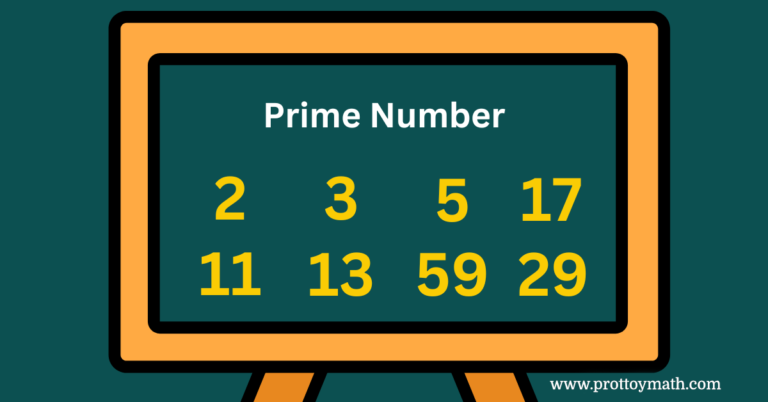
Do you know how to determine prime numbers quickly and in a nutshell? This article covers the concept of finding prime numbers (both small and large) using various methods. By the definition of a prime number, we know that prime numbers have only two positive divisors. The two divisors or factors would be 1 and the original number itself. Hence, we need to find here the numbers that consist of only two divisors.
It is easy to find prime numbers using a simple method, which is called prime factorization, and another method, “Sieve of Eratosthenes”. Hey, Math Geeks, we will learn to determine prime numbers between 1 and 100 using both methods.
Let’s do it
How to find prime numbers easily
There are different methods to calculate whether a number is prime or not. The factorization method is the easiest way to find prime numbers. By factorization, the factors of a number are found, and thus, one can easily identify a prime number.
Method One: Finding Prime Numbers Using Factorization
Factorization is the best way to find prime numbers. The steps involved in using the factorization method are:
Step one: First, find the factors of the given number
Step two: Check the factor number of that number
Step three: If the factor number is greater than two, it is not a prime number.
For Example: Take a number, say, 72.
Now, 72 can be written as
72 = 1 × 72
72 = 2 × 36
72 = 3 × 24
72 = 4 × 18
72 = 6 × 12
72 = 8 × 9
So, the factors of 72 here are 1, 2, 3, 4, 6, 8, 9, 12, 18, 24, 36, and 72. Since the number of total factors of 72 is 12, which is greater than 2, 72 is not a prime number but a composite number.
Composite numbers
A number that has more than two factors is called a composite number. In other words, a number that is not prime is called a composite number.
For example, 4 is a composite number because it has a total of three factors, i.e., 1, 2, and 4. Hence, 4 is exactly divisible by all its factors.
Now, if we take the example of 29. The prime factors of 19 are 1 and 19. Hence, it is a prime number.
Method Two: Sieve of Eratosthenes – Prime numbers 1 to 100
The sieve of Eratosthenes is a method for finding prime numbers and composite numbers within a group of numbers. This method was introduced by the Greek mathematician Eratosthenes in the third century BC.
With the help of the Sieve of Eratosthenes, we can easily check whether a number is prime or not. Now, here we draw a table and encircle the prime numbers from 1 to 100 using the Sieve of Eratosthenes method. Since we have already discussed prime and composite numbers above, it will be more convenient to find the difference between them.
The steps for calculating prime numbers from 1 to 100 are as follows:
Step one: First, enter all natural numbers from 1 to 100 in a table, as shown in the figure below.
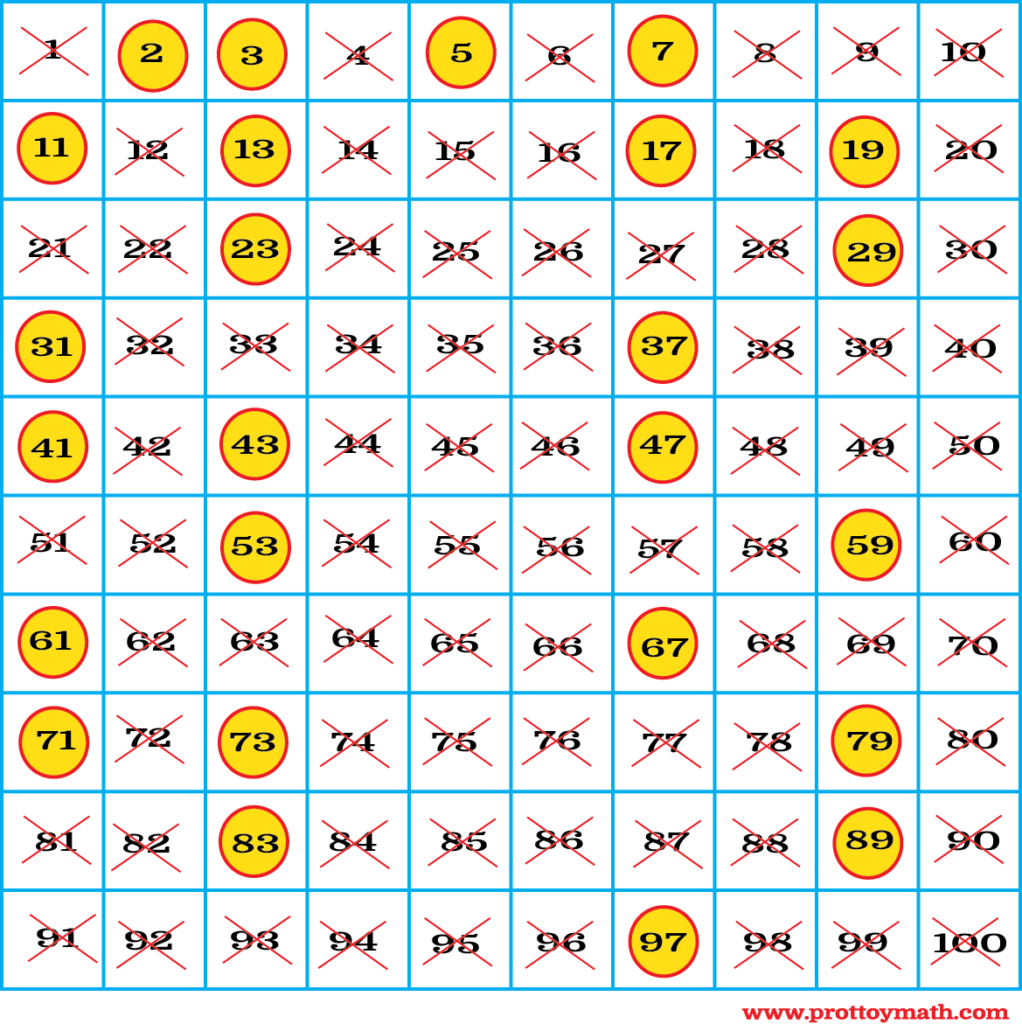
Step two: Put a cross over 1, as it is neither a prime number nor a composite number.
Step three: Now, circle the number 2 (which is a prime number) and cross all the multiples of 2, like 4, 6, 8, 10, 12, etc. Since all multiples of 2 are composite.
Step four: Next, circle the number 3 and put a cross over all multiples of 3, like 6, 9, 15, 21, etc. Except for 3, all its multiples are composite.
Step five: Again, circle the number 5 (since it only has two factors), and put a cross over all multiples of 5.
Step six: Now circle 7 and cross all multiples of 7
Step seven: Continue the process until all the numbers are either enclosed or crossed.
Prime numbers vs composite numbers
Some of the differences between prime numbers and composite numbers are tabulated below:
| Prime Number | Composite Number |
| A prime number has only two factors. | A composite number has more than two factors. |
| It is divisible by 1 and the number itself. For example, 3 is divisible by 1 and 3. | It can be divided by all its factors. For example, 4 is divisible by 1, 2 and 4. |
| Example: 2, 3, 7, 11, 109, 113, 181, 191, etc. | Example: 4, 8, 10, 15, 85, 114, 184, etc. |
Frequently Asked Questions
Is 2 a prime or a composite number?
2 is a prime number because it has only two factors, namely 1 and 2.
Is 1 a composite number?
No, because 1 does not have more than two factors; it has only 1 factor. Therefore, it is neither prime nor composite.
How many composite numbers are there between 10 and 20?
There are four composite numbers between 10 and 20. They are 11, 13, 17, and 19.
Can prime numbers be negative?
Since prime numbers are positive integers greater than one, they cannot be negative.